
Agent Orchestration Patterns: GroupChat, Debate, and Reflection
Master the three essential patterns for coordinating multiple AI agents: GroupChat for collaboration, Debate for refinement, and Reflection for quality assurance.

Multi-agent systems have emerged as a powerful paradigm for solving complex problems that require diverse expertise, iterative refinement, and collaborative decision-making. Understanding the right orchestration pattern is crucial for building effective agent-based applications.
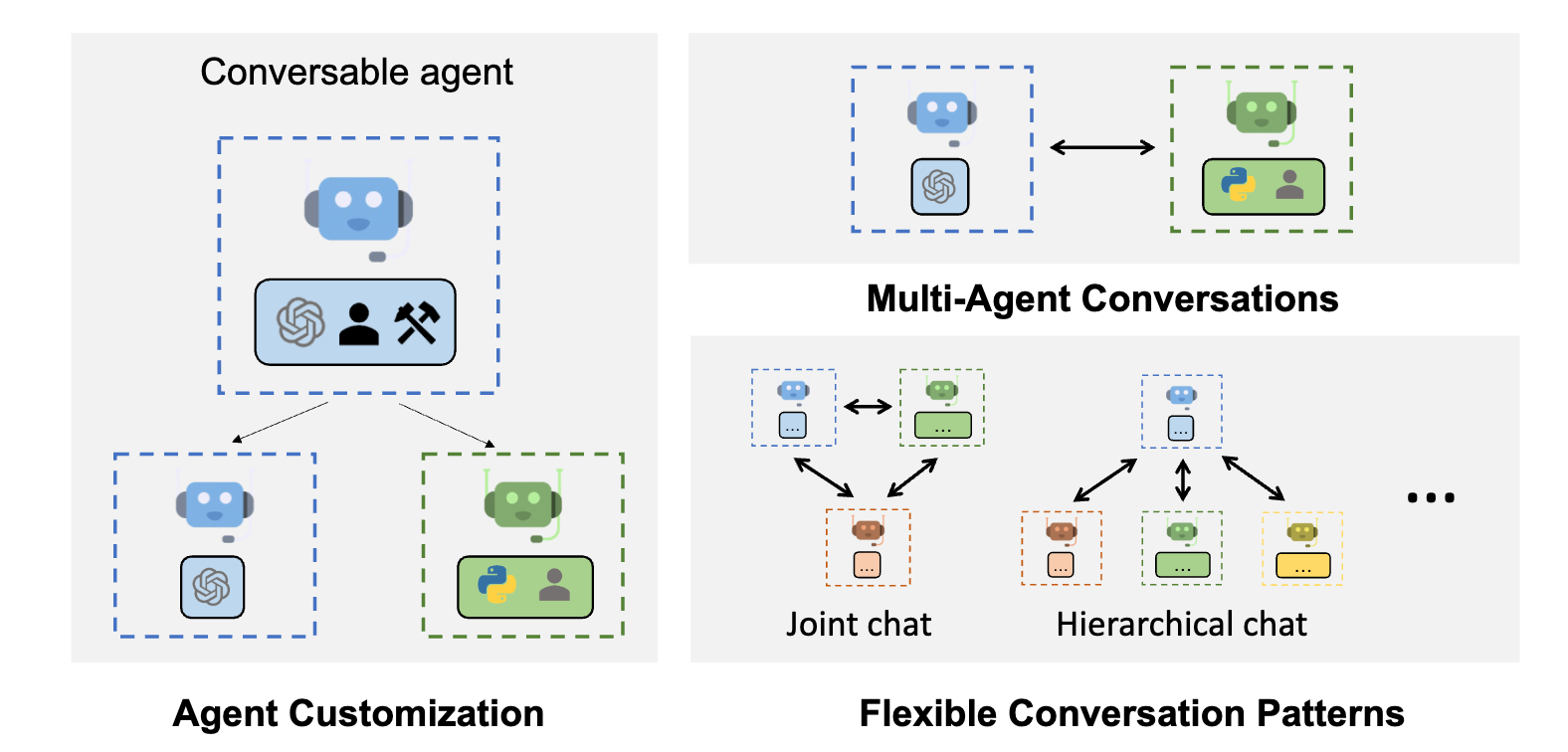
What are Agent Orchestration Patterns?
Agent orchestration patterns define how multiple AI agents interact, communicate, and coordinate to accomplish tasks. Rather than relying on a single monolithic agent, these patterns enable specialized agents to work together, each contributing their unique capabilities.
The three most important patterns are:
- GroupChat: Democratic multi-agent conversations with dynamic speaker selection
- Debate: Adversarial interactions where agents challenge and refine ideas
- Reflection: Self-critique and iterative improvement cycles
Each pattern serves different purposes and excels in specific scenarios.
The GroupChat Pattern
What is GroupChat?
The GroupChat pattern enables multiple agents to participate in a shared conversation where any agent can contribute based on the current context. A moderator or selection mechanism determines which agent speaks next.
How It Works
from autogen import GroupChat, GroupChatManager, AssistantAgent

# Define specialized agents
researcher = AssistantAgent(
    name="Researcher",
    system_message="You research facts and gather information."
)

analyst = AssistantAgent(
    name="Analyst",
    system_message="You analyze data and provide insights."
)

writer = AssistantAgent(
    name="Writer",
    system_message="You write clear, engaging content."
)

# Create group chat
groupchat = GroupChat(
    agents=[researcher, analyst, writer],
    messages=[],
    max_round=10
)

manager = GroupChatManager(groupchat=groupchat)
When to Use GroupChat
- Complex tasks requiring multiple perspectives
- Research and analysis workflows
- Content creation with fact-checking
- Multi-domain problem solving
- Collaborative code reviews
Benefits
✅ Diverse expertise in one conversation
✅ Dynamic speaker selection
✅ Scalable to many agents
✅ Natural conversation flow
✅ Reduced single-point-of-failure risk
The Debate Pattern
What is Debate?
The Debate pattern pits agents against each other in constructive opposition. Agents propose, critique, and defend ideas, leading to refined solutions through adversarial collaboration.
Architecture
from autogen import AssistantAgent, UserProxyAgent

# Create debating agents
proposer = AssistantAgent(
    name="Proposer",
    system_message="""You propose solutions and defend them.
    Be creative and confident in your proposals."""
)

critic = AssistantAgent(
    name="Critic",
    system_message="""You critically evaluate proposals.
    Find weaknesses, edge cases, and potential issues."""
)

judge = AssistantAgent(
    name="Judge",
    system_message="""You evaluate both arguments and
    synthesize the best solution."""
)

# Orchestrate debate rounds
def debate_workflow(topic, rounds=3):
    messages = []
    for round_num in range(rounds):
        # Proposer speaks
        proposal = proposer.generate_reply(messages)
        messages.append({"role": "proposer", "content": proposal})

        # Critic responds
        critique = critic.generate_reply(messages)
        messages.append({"role": "critic", "content": critique})

    # Judge synthesizes
    verdict = judge.generate_reply(messages)
    return verdict
Real-World Applications
Code Review: One agent proposes implementation, another finds security issues
Architecture Design: Multiple agents debate scalability vs. simplicity
Content Quality: Writer creates content, editor challenges clarity
Decision Making: Agents represent different stakeholder perspectives
Debate vs GroupChat
| Feature | Debate | GroupChat |
|---|---|---|
| Structure | Adversarial | Collaborative |
| Turn-taking | Predictable | Dynamic |
| Purpose | Refinement | Exploration |
| Agent roles | Fixed opposition | Flexible |
| Best for | Quality improvement | Broad problem solving |
The Reflection Pattern
What is Reflection?
Reflection enables agents to critique their own outputs, identify weaknesses, and iteratively improve before delivering final results. It's the agent equivalent of "measure twice, cut once."
Implementation
from autogen import AssistantAgent

# Primary agent
generator = AssistantAgent(
    name="Generator",
    system_message="You generate solutions to problems."
)

# Reflection agent
reflector = AssistantAgent(
    name="Reflector",
    system_message="""You review solutions and provide
    constructive criticism. Focus on:
    - Correctness
    - Edge cases
    - Efficiency
    - Best practices"""
)

def reflection_loop(task, max_iterations=3):
    """
    Iteratively improve output through reflection
    """
    current_solution = generator.generate_reply([
        {"role": "user", "content": task}
    ])

    for iteration in range(max_iterations):
        # Reflect on current solution
        reflection = reflector.generate_reply([
            {"role": "user", "content": f"""
            Review this solution:
            {current_solution}

            Provide specific improvements.
            """}
        ])

        # Check if reflection indicates completion
        if "looks good" in reflection.lower():
            break

        # Improve based on feedback
        current_solution = generator.generate_reply([
            {"role": "assistant", "content": current_solution},
            {"role": "user", "content": f"""
            Based on this feedback:
            {reflection}

            Improve the solution.
            """}
        ])

    return current_solution
Why Reflection Matters
💡 Quality Assurance: Catches errors before delivery
💡 Self-Improvement: Agents learn from mistakes
💡 Reduced Iterations: Fewer human review cycles
💡 Consistency: Maintains standards automatically
Combining Patterns
The most powerful systems combine multiple orchestration patterns:
Example: Research Report Generation
1. GroupChat: Researcher + Domain Expert gather information
2. Debate: Two analysts debate interpretation of data
3. Reflection: Writer creates report, reflector reviews quality
4. GroupChat: All agents review final draft
Pattern Selection Matrix
| Use Case | Primary Pattern | Secondary Pattern |
|---|---|---|
| Content creation | Reflection | GroupChat |
| Technical decisions | Debate | Reflection |
| Research synthesis | GroupChat | Reflection |
| Code generation | Reflection | Debate |
| Strategic planning | Debate | GroupChat |
Best Practices
For GroupChat
✅ Limit to 3-7 agents for manageable conversations
✅ Give agents distinct, non-overlapping roles
✅ Use clear speaker selection criteria
✅ Monitor conversation depth to prevent loops
✅ Implement conversation summarization for long chats
For Debate
✅ Define clear evaluation criteria for the judge
✅ Limit debate rounds (3-5 typically sufficient)
✅ Ensure balanced speaking time
✅ Document reasoning chains
✅ Separate proposal from critique phases
For Reflection
✅ Set quality thresholds for completion
✅ Limit iteration count to prevent infinite loops
✅ Use specific, actionable feedback prompts
✅ Track improvement metrics across iterations
✅ Cache intermediate results
Common Mistakes
❌ Too Many Agents: More than 10 agents creates chaos
❌ Unclear Roles: Overlapping agent responsibilities
❌ No Exit Conditions: Conversations that never end
❌ Ignoring Costs: Each message costs API tokens
❌ Missing Context Management: Exceeding context windows
❌ Over-Engineering: Using complex patterns for simple tasks
Performance Considerations
Token Management
# Track and limit token usage
from autogen import OpenAIWrapper

config = {
    "model": "gpt-4",
    "max_tokens": 2000,
    "temperature": 0.7
}

# Implement token budgets per agent
def create_agent_with_budget(name, budget):
    return AssistantAgent(
        name=name,
        llm_config={**config, "max_tokens": budget}
    )
Conversation Pruning
For long GroupChats, implement message summarization:
def prune_messages(messages, max_length=10):
    """Keep recent messages + summarize older ones"""
    if len(messages) <= max_length:
        return messages

    # Keep recent messages
    recent = messages[-max_length:]

    # Summarize older messages
    old_messages = messages[:-max_length]
    summary = summarizer.generate_reply([{
        "role": "user",
        "content": f"Summarize: {old_messages}"
    }])

    return [{"role": "system", "content": summary}] + recent
Real-World Use Cases
Software Development
Pattern: Reflection + Debate
1. Generator creates code
2. Reflector checks for bugs and style issues
3. Security agent debates security implications
4. Performance agent debates optimization
Content Marketing
Pattern: GroupChat + Reflection
1. SEO expert provides keyword strategy
2. Writer creates content
3. Editor reflects and suggests improvements
4. Brand expert ensures voice consistency
Data Analysis
Pattern: GroupChat + Debate
1. Data collector gathers metrics
2. Statistician analyzes patterns
3. Domain expert debates interpretations
4. Visualization expert presents findings
Customer Support
Pattern: Reflection
1. Agent drafts response
2. Reflector checks tone and accuracy
3. Compliance agent validates policy adherence
4. Final response delivered
Tools and Frameworks
AutoGen (Microsoft)
Best for: GroupChat and multi-agent conversations
pip install pyautogenLangGraph (LangChain)
Best for: Complex state machines and conditional routing
pip install langgraphCrewAI
Best for: Role-based agent collaboration
pip install crewaiConclusion
Agent orchestration patterns—GroupChat, Debate, and Reflection—provide structured approaches to multi-agent collaboration. Each pattern addresses different aspects of problem-solving:
- GroupChat for diverse perspectives and exploration
- Debate for quality through adversarial refinement
- Reflection for self-improvement and error reduction
The key to success is matching patterns to problems. Start simple with Reflection for single-task improvements, add Debate when you need validation, and scale to GroupChat when complexity demands multiple specialists.
As AI agents become more capable, orchestration patterns will be the difference between chaotic agent interactions and elegant, efficient problem-solving systems.
Next Steps
- Experiment with AutoGen's GroupChat examples
- Build a simple reflection loop for code review
- Combine patterns for your specific use case
- Monitor costs and optimize token usage
🚀 Start orchestrating smarter agent systems today!